Who gets control of the compute?
The AI-debt series, Part 3
The AI-debt series, Part 3
PIE
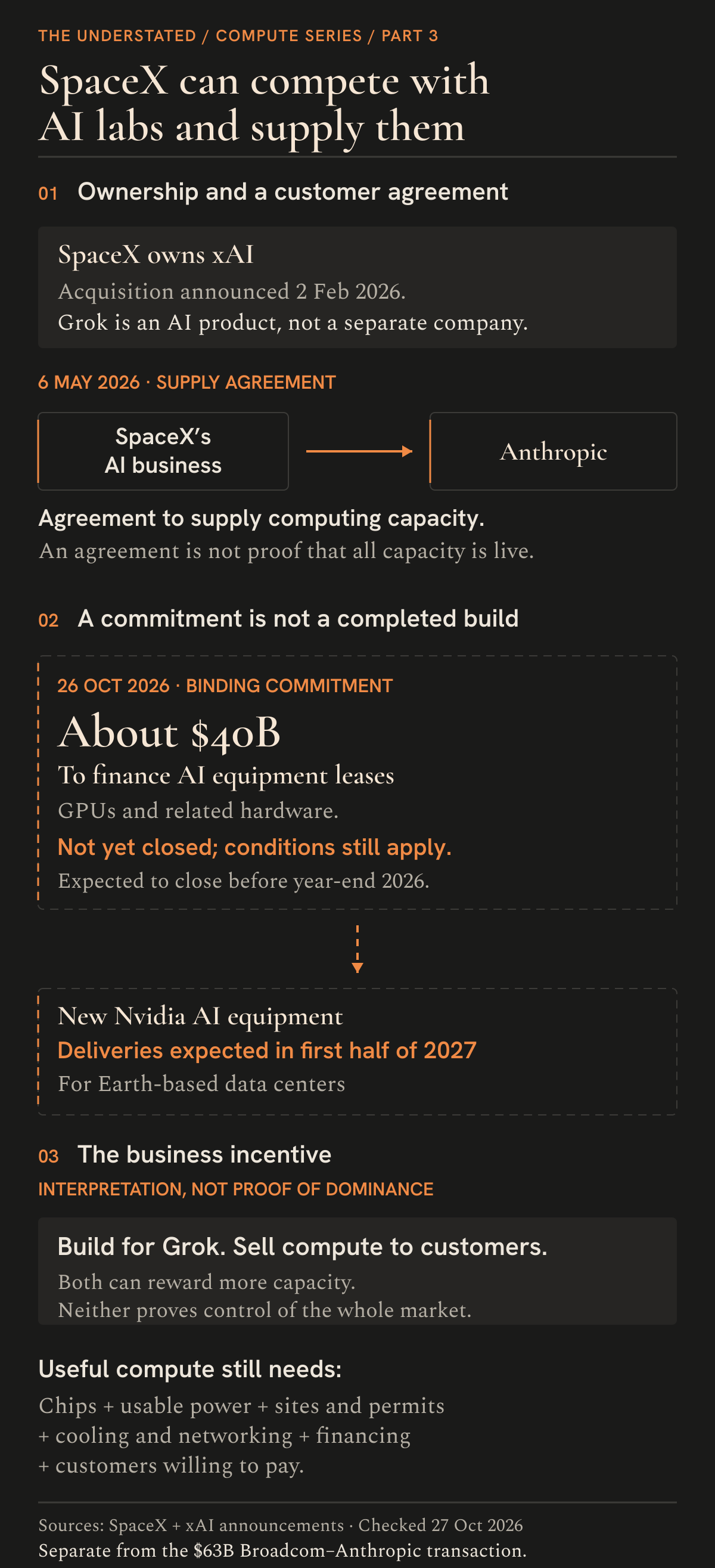
What’s going on. SpaceX, which acquired the AI company xAI on Feb 2, announced on Oct 26 a binding commitment for roughly $40bn of finance leasing for graphics processing units, or GPUs, through an entity managed by Apollo. GPUs are chips commonly used to train and run AI models. A finance lease lets a company use equipment while paying over time; this equipment is scheduled for delivery in the first half of 2027. Closing is subject to conditions and expected before year-end. A day earlier, Elon Musk posted that lenders had almost shut off money to companies without substantial revenue outside AI data centers, and predicted that few of the more than 200 neoclouds, firms that rent out AI computing, would survive.
Why it matters. Musk describes a market where a few well-financed landlords own the computing others rent. SpaceX says it “aims to deploy the largest compute infrastructure in the world,” an ambition from an interested competitor. Control takes more than borrowing: chips must arrive, power must be connected, machines must work and customers must pay. Our analysis suggests bargaining power sits with whoever controls the tightest step, when others lack alternatives.
The history. In the late 1990s, builders of long-haul fiber-optic networks overbuilt. A 2003 Richmond Fed journal study traced the glut to three causes: a young industry overshooting, each strand of fiber possibly carrying more than builders anticipated, and demand growing slower than many had forecast. Owning capacity didn’t guarantee earning from it.
Three kinds of control
Compute means the processing work computers provide. A rack is a cabinet holding computing equipment. Big numbers about AI computing blur three things. Spending capacity is money committed to buying equipment. Technical capacity is equipment installed, powered and working. Economic control is the ability to set terms because customers need what you have. A company can hold the first without the other two.
The chain, and its narrowest link
financing --> chips delivered --> power and permits --> working capacity --> paying customersEliyahu Goldratt’s theory of constraints holds that a system can produce only as much as its narrowest step allows. Widen that step and the limit moves somewhere else.
A simplified example, with invented numbers and identical racks that draw equal power and do equal work when running: a company finances 100 racks, its grid connection and permits can power at most 60, and customers want computing equal to 45 racks.
Power caps potential usable capacity at 60. That doesn’t prove 60 are working: installation, connection and testing are separate steps, and utilization is another question. Even if all 60 are ready for service, our simplified demand assumption supplies at most 45 racks’ worth of paying work. That leaves 40 racks without available power and at least 15 available racks without paying work, with payments due on all 100.
Our inference is that bargaining follows the binding step, when the other side lacks alternatives. A connected site can set terms while power is scarce and tenants have nowhere else to go. Chip shortages work similarly, though financing alone neither creates nor ends one. In the example, unused capacity puts pressure on the seller.
Where SpaceX sits on the chain
The $40bn sits at the first link: a binding commitment for ground-based NVIDIA Vera Rubin systems, with a conditional closing still ahead, per SpaceX’s announcement. Musk’s post said SpaceX had closed $40bn of debt for GPUs; we follow the company’s more detailed announcement.
Further down the chain, SpaceX has a customer. Anthropic said on May 6 it had agreed to use all of the compute capacity at SpaceX’s Colossus 1 data center, more than 300 megawatts and over 220,000 NVIDIA GPUs, with access expected within the month. That is a customer agreement with an expectation of access. It doesn’t show that the machines were delivered, working or fully used, and the evidence we reviewed has no utilization figure. Anthropic also expressed interest in multiple gigawatts of orbital computing with SpaceX, without establishing operating orbital capacity.
xAI’s data centers support the Grok AI platform, and in our read Grok competes for many of the same users as Claude. SpaceX agreed to supply computing to a rival of its own AI business. The agreement offered Anthropic access it expected within the month and gave SpaceX a customer for Colossus 1.
What SpaceX’s filings warn about
SpaceX’s quarterly reports for the periods ended June 30, filed Aug 4, and Sept 30 describe how this business could weaken. Cloud customers are concentrated, so a few buyers matter a great deal. Some could cancel after an initial ramp-up, build their own data centers or shift to competing platforms. More efficient AI models could reduce demand for compute.
The Sept 30 report, in the Revenue section for SI on printed page 42, says contracts are typically three years and “terminable by either party upon 90 days’ notice.” That describes the typical contracts, not necessarily every customer agreement. A three-year term with that exit right may lock in much less revenue than its length suggests.
Revenue in the segment that includes this cloud business also includes subscriptions, apps and advertising, so it isn’t a clean measure of compute rent. And installed, or nameplate, power is a rated maximum that measures neither utilization, as the Sept 30 report notes, nor market share.
The power step, and the government’s argument
Power is where xAI’s computing has met the courts. In June, the Justice Department asked to intervene in and dismiss a private citizen lawsuit seeking to power down a large AI facility in Southaven, Mississippi. Its motion says xAI uses temporary gas-fired turbines to power data centers supporting Grok, and that Mississippi’s environmental regulator determined the state’s plan didn’t require Clean Air Act permits for them.
The department argued that the lawsuit would turn off critical power during an energy emergency and hinder the War Department’s use of AI for national defense, citing a declaration from the Department of War’s chief digital and AI officer describing Grok’s continued operation as a national-security matter. An Oct 19 opinion allowed the United States to intervene but denied its request to dismiss the suit unilaterally. The court said national-security concerns were not relevant to that procedural question. It did not thereby reject Grok’s national-security value, find a permitting violation or order turbines shut down. The defendants’ separate dismissal motion remained reserved.
For compute, the local stake is power. If a court entered an enforceable order restricting the turbines, the electricity available at that site could fall. We assume no outcome, and a case that stays open isn’t by itself evidence of lost power or strategic failure.
American fortress is our shorthand for the idea behind the argument: compute treated as strategic infrastructure worth federal defense. We use it as an analytical label, not the name of a documented official program. Federal support in one lawsuit settles no permitting question elsewhere and guarantees nothing to lenders financing new chips.
What telecom’s fiber teaches here
The fiber builders had counted on new applications to fill the bandwidth, and demand had not grown as fast as many had forecast. Capacity per strand may also have grown more than they anticipated. A more efficient AI model is the computing version, getting more work from each chip. SpaceX’s filings name efficiency as a demand risk; cheaper AI can also widen use.
The comparison has limits. The authors credited a 1996 telecom law and fast technical change with shaping that boom, rejected a pure-speculation explanation, and made no prediction about AI. The Vera Rubin systems in SpaceX’s financing are scheduled for 2027, so their use can’t be judged yet.
The case for many landlords
The fair alternative is that compute stays broadly available. Anthropic itself has more than one source lined up: an announced Broadcom equipment lease through a separate company (Part 2), with deliveries expected from 2027, and its Colossus 1 agreement. Customers who can switch suppliers, build their own or need fewer chips per task are hard for one landlord to squeeze. If fewer alternative suppliers remain, smaller AI businesses could have less bargaining power over price and access. Musk’s predicted shakeout would favor survivors like SpaceX, and he has a stake in that outcome.
What would change this read
SpaceX’s bargaining position would strengthen with the $40bn closing on its stated terms and the Vera Rubin systems arriving on schedule, filings reporting utilization alongside nameplate power, longer or harder-to-end customer contracts, compute rent reported separately and growing, and evidence that rival renters truly can’t raise money. It would weaken if customers exercise termination rights or build their own, if efficiency cuts demand per task, if the power step stalls, or if an enforceable order restricts turbine power at Southaven.
SpaceX holds a financing commitment, a major customer and an ambition. Which of them turns into bargaining power depends on the scarcest step once the chips arrive.
Source note, Oct 27, 2026: The xAI acquisition announcement (Feb 2), Anthropic’s Colossus 1 announcement (May 6), the Justice Department’s June 16 release and June 15 motion, Musk’s Oct 25 post, the Oct 26 joint Broadcom financing announcement and the Richmond Fed study (Couper, Hejkal and Wolman, Fall 2003; views the authors’) were reopened during the v1 drafting run. SpaceX’s Oct 26 financing announcement and its quarterly reports for the periods ended June 30 (filed Aug 4; risk factors, printed pages 51 and 52) and Sept 30 (segment and cloud-service discussion) were checked by Puck and the commissioning team on Oct 27, who supplied locators and, for the announcement, a short exact excerpt; Chief did not independently reopen them. Other findings from the quarterly reports are Puck-supplied paraphrases. For this revision, Puck’s reviewer freshly reopened the Sept 30 report, Revenue section for SI, printed page 42, and supplied the exact termination clause quoted above; Chief did not independently reopen that filing. The Sept 30 filing date was not supplied. Not established in the reviewed evidence: whether the $40bn has closed, actual delivery and utilization at Colossus 1 or any SpaceX site, customer-concentration percentages, customer-specific variations from the typical contract terms, and developments after the Oct 19 opinion. Chief reopened the filed Oct 19 opinion, case 3:26-cv-00074-DMB-JMV, Document 135: pages 1 and 21 to 22 establish the split result, page 8/note 6 limits the national-security discussion, and page 21/note 11 reserves the defendants’ separate dismissal motion. The opinion was read from a public copy hosted by Ars Technica. The Southaven facility and Colossus 1 are treated as separate sites. This piece makes no forecast.