Why would Wall Street finance this?
The AI-debt series, Part 2
The AI-debt series, Part 2
PIE
What’s going on. On Oct 26, Bank of America, Blackstone, Citi and Morgan Stanley announced a $63bn financing. A newly formed company will buy Broadcom’s AI chips and networking gear and lease them to Anthropic, the maker of the Claude AI models. Blackstone is the sole provider of the committed part of the junior loan, which has a lower repayment claim than the senior loan the three banks are arranging. Deliveries are expected to start in 2027.
Why it matters. Does serious institutional money make an AI-infrastructure bubble less likely? Blackstone’s junior commitment is meaningful evidence that an experienced lender will take risk on this particular financing. Broadcom’s support is sized to the senior, or first-lien, portion; that does not establish the same protection for Blackstone’s junior loan. How much it tells us depends on the amount, the pricing and how much Blackstone keeps, none of which is public. It doesn’t estimate bubble odds across the market or rule out mispricing.
The history. Telecom in the late 1990s is the warning case. Economists writing in the Richmond Fed’s journal rejected the pure-speculation story for that boom, yet the communications industry lost nearly $20bn in 2001 while spending on telecom services kept climbing. Lucent, an equipment maker, had used vendor loans and guarantees to help customers buy its gear.
The company in the middle
A special-purpose vehicle, or SPV, is a separate company set up for one job. This one will buy Broadcom’s accelerators and networking equipment and lease them to Anthropic. Accelerators are chips built to run AI calculations. Anthropic uses the hardware and pays rent. The lenders’ money goes into the SPV, which pays Broadcom.
EQUIPMENT  Broadcom ---chips and gear---> SPV ---leased to---> Anthropic

CASH IN    Lenders ---loans---> SPV ---purchase price---> Broadcom
CASH BACK  Anthropic ---rent---> SPV ---loan payments---> Lenders

BACKSTOP   Broadcom ---residual-value support, only if
                       contract conditions are met---> SPV
Simplified from the announced roles; the rent and loan-payment arrows show how such lease financings generally work. This deal’s payment order, pricing and loss rules aren’t disclosed.
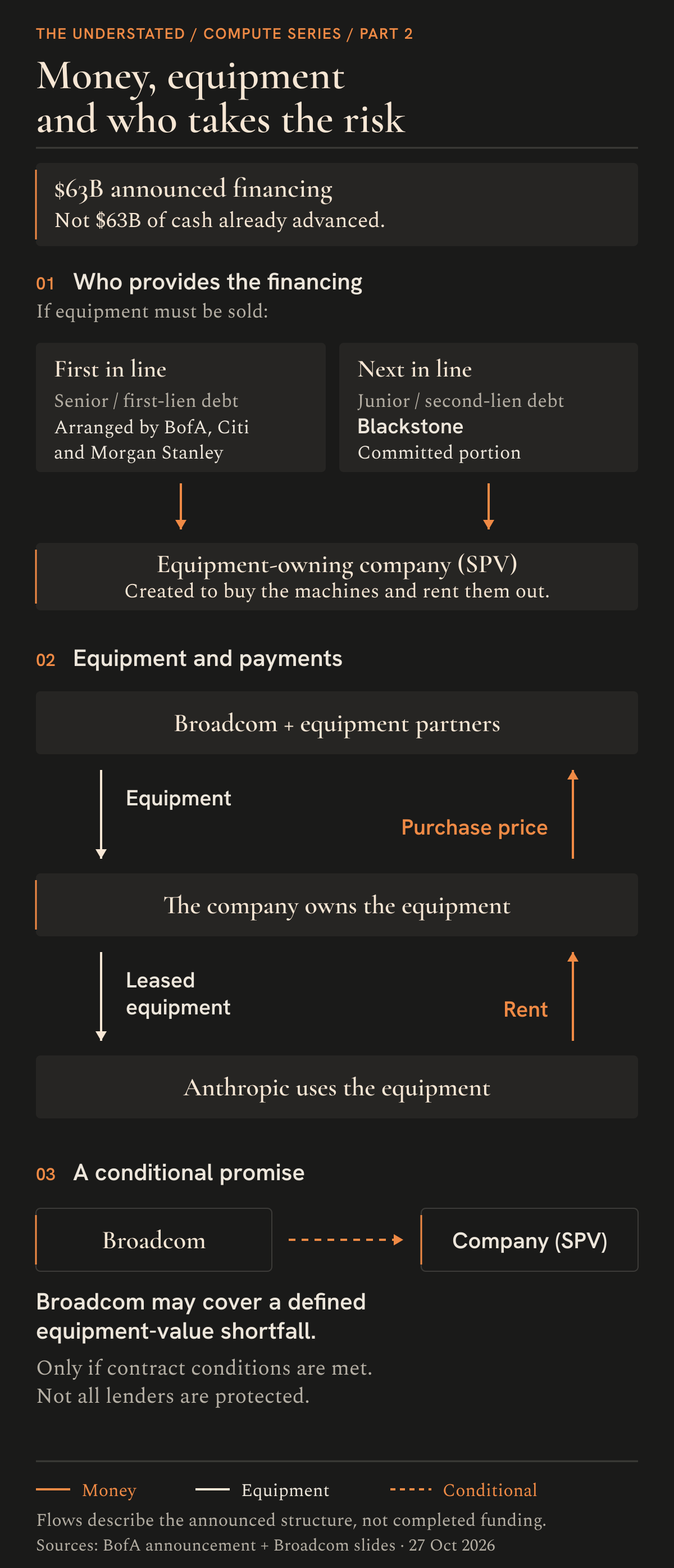
Who stands where in line
A lien is a lender’s legal claim on property if the borrower stops paying. First-lien lenders have priority over second-lien lenders in recovering from collateral. The second-lien loan ranks below senior debt. After any lower-ranking capital is exhausted, second-lien lenders generally take losses before first-lien lenders. We don’t know whether equity or other protection absorbs losses before Blackstone.
Blackstone is the sole provider of the committed portion of the second-lien financing. Bank of America, Citi and Morgan Stanley are arranging the first lien, meaning they organize the loan and may sell parts of it to other investors. The release did not disclose the loan breakdown, so we don’t know who will finally hold the senior debt or Blackstone’s dollar commitment.
A commitment is a promise to lend once agreed conditions are met. The announcement of commitments does not establish that all $63bn has already been funded.
What a junior seat can signal
Economists call evidence like Blackstone’s choice costly signaling. A signal is believable when sending a false one would be expensive. A carmaker offering a 10-year warranty pays for covered repairs, so the warranty tells buyers something an advertisement can’t.
In lending, the cost is exposure kept. If the rent stopped and the racks sold for less than the debt, the second-lien layer would take losses before the first lien. Holding that seat means carrying two risks: the tenant stops paying, and the equipment is worth too little if it does. That is why institutional confidence deserves a fair hearing: a junior seat is where careful credit work matters most.
Three unknowns limit the signal. Pricing: a lender paid enough can rationally accept a risk it considers serious. Amount: a small slice says less than a large one. Retention: the announcement doesn’t say how much Blackstone will keep, sell on or hedge. How much it ultimately retains or hedges affects the strength of that signal; the commitment itself can also carry risk.
So the commitment is meaningful evidence about this structured financing, tied to specific hardware and one tenant’s rent. It doesn’t measure bubble odds across AI, and careful lenders can still misprice risk.
What the Richmond economists rejected
In their 2003 study, economists Elise Couper, John Hejkal and Alexander Wolman described the bubble view as prices staying high because people expected them to stay high, with no expectation of high future dividends. They rejected it. High stock prices and heavy investment, in their reading, appear to have rested on beliefs about future profits that proved too optimistic.
That isn’t a bubble under the definition they tested, and it still produced heavy losses. In this deal, a junior lender is repaid from rent and, failing that, from the equipment; Blackstone’s exit plans and hedges aren’t public. Its commitment says little about whether the demand forecasts behind that rent are too high.
What Broadcom promised
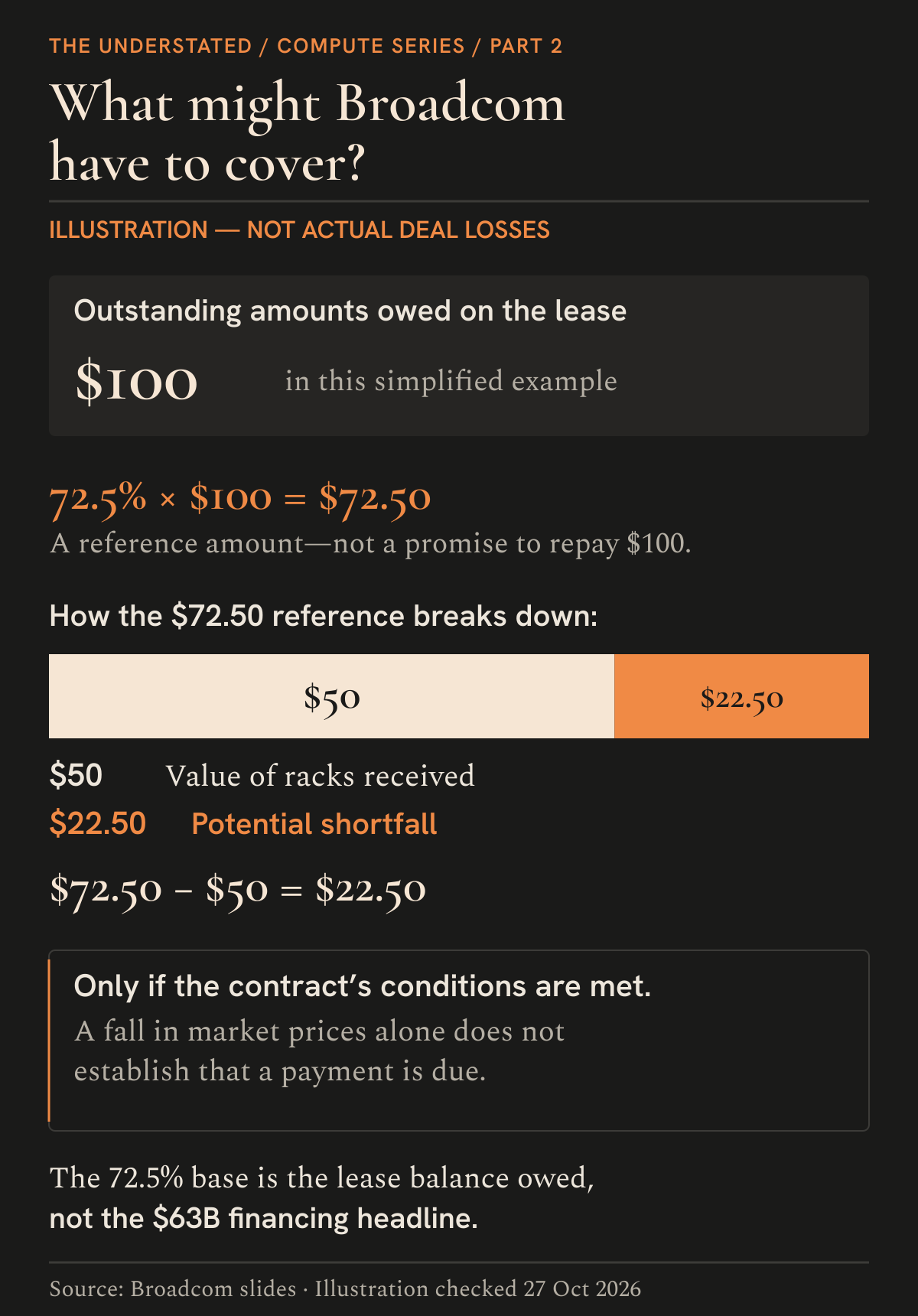
Broadcom gives residual-value support to the SPV for an amount equivalent to the first-lien portion. A rack is a cabinet holding computing equipment. Residual value means what equipment is worth later in its life. Broadcom’s investor slides define its potential liability as the shortfall between 72.5% of the lease amount still outstanding and the value of the racks received.
With made-up round numbers: say $100 is still owed on the lease. The threshold is 72.5% of that, or $72.50. If the racks are worth $80, the formula produces nothing. If they’re worth $50, the gap is $72.50 minus $50, or $22.50, and that amount could come due only if the contract’s triggering conditions occur. The percentage applies to the outstanding lease balance, not to $63bn, and it doesn’t cover every fall in value.
Separate deals, separate numbers
Reuters reported that Apollo and Blackstone earlier agreed to finance a $35bn expansion of Anthropic’s computing capacity, with a Broadcom backstop of up to $29bn. Anthropic’s S-1, the regulatory filing for its planned share sale, describes a conditional facility for up to $42bn of convertible notes, loans that can later turn into shares, issuable to Broadcom or a permitted assignee solely to pay quarterly rent. None was outstanding at June 30. After an initial public offering, conversion would use market-linked pricing. The earlier financing and its backstop, the conditional $42bn note facility, and the new $63bn structure are not established as identical or additive.
The case for building early
The strongest counterargument is that the shortage is real. Anthropic’s S-1 says “we have significantly underestimated our compute requirements,” and that buying too little limited its capacity. In the first half of 2026 it reported an operating loss alongside $3.929bn of cash coming in from operations. At June 30 it held $131.651bn in cash, cash equivalents and short-term investments.
A loss and a cash inflow can coexist because of timing. As an illustration, a customer who pays a year ahead adds cash today, while the revenue is counted as the service is delivered. A June 30 snapshot doesn’t justify calling the company cash-starved.
The filing says customer revenue often comes without long-term commitments, while compute costs stretch over years. A cash balance describes one day; rent is a string of future bills. Building ahead of signed revenue can pay off when future receipts cover the bills. Weak demand or lower rental prices can upset that calculation.
Lucent’s lesson, and its limits
Lucent’s 2002 annual filing, discussing customer financing commitments, used the phrase “as a condition of obtaining or bidding on infrastructure projects.” Those commitments reached $8.1bn in September 2000, and the downturn later damaged its results and cash flow.
Lucent made loans and guarantees for customers; Broadcom’s support is tied to the value of specific equipment in one SPV. Moody’s described Broadcom as one of the strongest large technology companies, but warned that risk would rise if multiple transactions were undertaken over a short period to fund frontier AI labs.
Consumption of telecom services rose from about $88bn in 1995 to $151bn in 2001, in constant 1996 dollars, according to the Richmond study. The industry lost nearly $20bn in 2001 anyway. Usage and returns are separate tests.
What would change this read
Blackstone’s signal would count for more if its committed amount, pricing and retained share were disclosed. Later Anthropic filings showing longer customer commitments would ease the timing worry. The read would weaken if Broadcom stacks up backstops quickly, as Moody’s flagged, or if rack values fall relative to the lease balances still outstanding, toward the point where the 72.5% formula produces a shortfall.
Blackstone’s junior loan is repaid from the rent or, failing that, from what the racks are worth. That makes the commitment useful evidence about one deal. Whether the wider build-out pays depends on demand arriving on time.
Source note, Oct 27, 2026: Deal roles, the SPV, the 2027 delivery expectation and Broadcom’s support to the SPV come from the Oct 26 joint announcement and Reuters’ Oct 26 report as published by CNA, both reopened during the v1 drafting run. The earlier $35bn expansion, the up-to-$29bn backstop and Moody’s comments are Reuters reporting; the Broadcom filing behind the $29bn was not reopened. The bubble definition and telecom data come from Couper, Hejkal and Wolman, Federal Reserve Bank of Richmond Economic Quarterly, Fall 2003, reopened during the v1 run; the views are the authors’, not the Federal Reserve’s. Anthropic’s figures, its compute-forecasting language and the note-facility terms come from its S-1 (printed pages 23, 32, 33, 137, 162 and 167 to 169, and cash-flow table F-13, Actual column). Lucent’s financing history comes from its fiscal 2002 10-K (MD&A, “Customer financing commitments,” printed pages 16 and 17). Puck and the commissioning team checked both filings on Oct 27 and supplied these locators and short excerpts; Chief did not independently reopen them. The S-1 figures are historical interim figures for the first half of 2026 and June 30, not current balances. Broadcom’s 72.5% formula comes from its investor slides, verified earlier by the commissioning team and recorded in the approved Part 1 source note; no slide excerpt was supplied for this revision. The $100 example is our own illustrative arithmetic. The commitment-risk qualification is informed by Bruche, Malherbe and Meisenzahl’s April 2017 Federal Reserve discussion paper, whose abstract describes arrangers retaining larger loan shares when investors pay less than expected; this is a general financing mechanism, not evidence of Blackstone’s specific distribution plans. Not established in the reviewed evidence: Blackstone’s committed amount, loan pricing, how much Blackstone or the arrangers will keep or hedge, final loan holders, the SPV’s ownership, recourse and accounting, the payment order, and the full contractual triggers for Broadcom’s support. This piece makes no forecast.